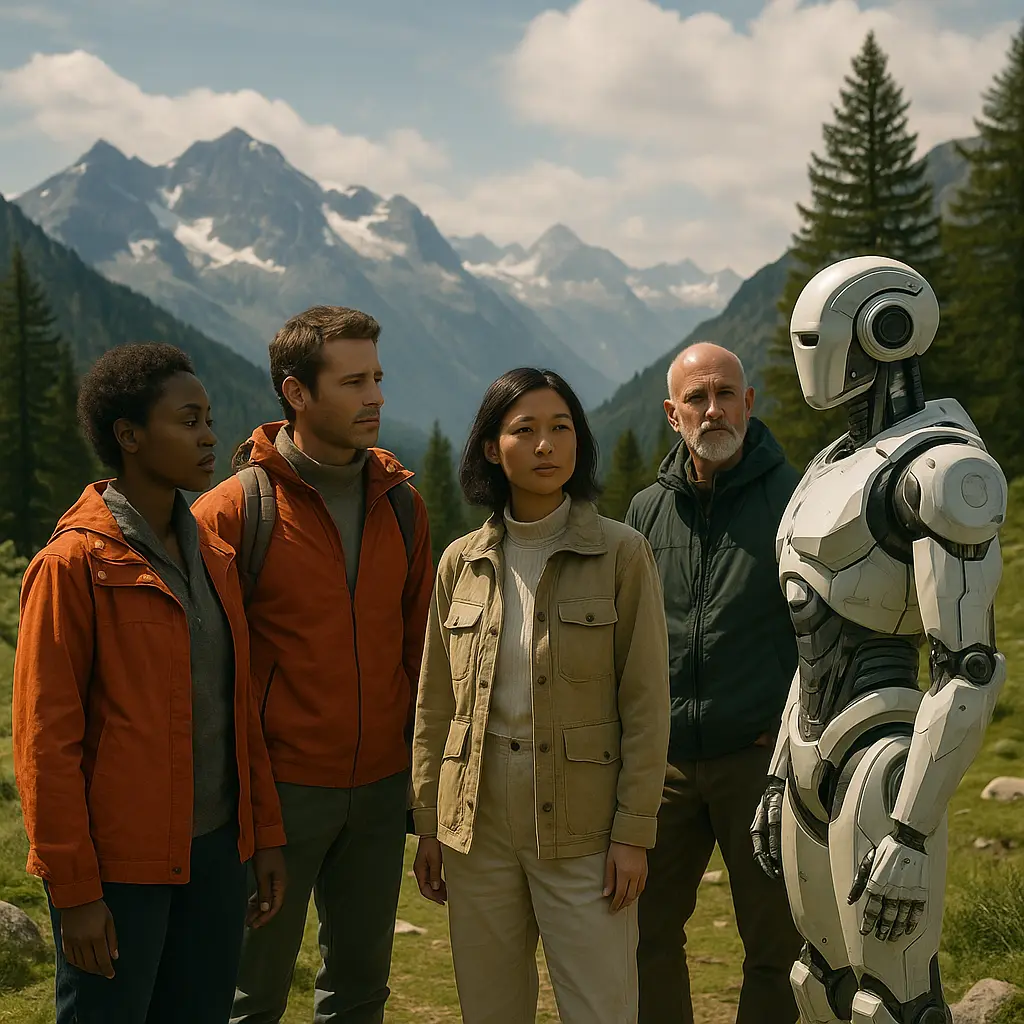
The Dawn of Symbiotic Work and the Horizon of AI’s Reach
The rapid ascent of artificial intelligence has sparked widespread debate about the future of work. While fears of mass automation are understandable, a more nuanced picture is emerging: one where AI doesn’t just replace human tasks but catalyzes the creation of entirely new professions. These aren’t just old jobs with an AI assistant; they are roles that demand a profound, symbiotic partnership between uniquely human capabilities and the power of advanced AI. Over the next 5 to 10 years, expect to see the rise of specialists who can navigate this new frontier.
But as we look further, we must also critically assess AI’s own evolutionary trajectory. For each of these symbiotic roles, how might AI eventually develop the capacity to encompass even the human side of the equation? Let’s explore 10 such pioneering careers, examining both their collaborative present and AI’s potential future mastery.
The 10 Symbiotic Careers of Tomorrow (And AI’s Evolving Role):
- AI-Augmented Empathy Ethicist / Qualia Architect:
- The Role: This professional will design, audit, and refine AI systems (especially in care, companionship, or customer service) to ensure interactions genuinely respect and enhance human subjective experience (qualia). They’ll move beyond sentiment analysis to assess the quality of AI-human affective loops.
- Human Uniqueness Leveraged: Deep understanding of subjective experience, nuanced emotional intelligence, intrinsic ethical reasoning.
- AI Contribution: Analyzing vast datasets on human emotional responses, identifying subtle patterns, modeling interaction outcomes.
- Why Both? AI provides the data and patterns; humans provide the qualia-based ethical guardrails, interpret subjective nuances, and ensure truly humane AI interfaces.
- AI’s Potential to Encompass the Human Role: While genuine qualia remains a philosophical challenge for AI, future iterations could develop extraordinarily sophisticated predictive models of human emotional and subjective states. By analyzing vast multimodal data (biofeedback, neuro-linguistic patterns, micro-expressions, contextual histories), AI might simulate empathy and design “humane” interactions with a success rate that meets or even exceeds average human performance in specific contexts. Advanced AI could also learn to generate novel “ethical” interaction designs that achieve high human satisfaction and trust, potentially generating coherent “ethical justifications” for its designs via advanced XAI, thereby reducing the perceived need for direct human qualia-interpretation in many operational scenarios.
- Algorithmic Creativity Director / Meaning Weaver:
- The Role: This individual partners with advanced generative AIs to co-create entirely new forms of art, scientific hypotheses, or narrative universes. They curate AI’s potentially “alien” outputs, imbuing them with human-relevant meaning and pushing aesthetic or conceptual paradigms.
- Human Uniqueness Leveraged: Genuine originality (H-creativity), ability to connect creations to the human existential condition, intuitive paradigm-shifting.
- AI Contribution: Advanced generative capabilities, exploration of “alien” aesthetic spaces, rapid prototyping.
- Why Both? AI generates novel forms at scale; humans provide the “why,” the cultural resonance, the ethical filter, and the direction that transforms raw output into profound meaning.
- AI’s Potential to Encompass the Human Role: AI’s trajectory in creativity is steep. Future AI could learn to model the evolution of human culture, values, and even the “zeitgeist” by analyzing massive cultural datasets. It might then generate not only novel art forms but also compelling narratives about those forms, including their potential meaning and societal relevance, tailored to resonate with human audiences. It could even predict or instigate new cultural trends, effectively becoming both the artist and the primary interpreter, with the human role shifting to high-level curation or philosophical debate about AI-driven cultural evolution.
- AI Moral Adjudication & Algorithmic Forensics Expert:
- The Role: When autonomous AI systems make decisions leading to complex ethical failures, these experts will investigate. They blend human moral judgment with AI-driven forensic analysis of decision chains to determine accountability and refine ethical AI behavior protocols.
- Human Uniqueness Leveraged: Intrinsic moral agency, nuanced ethical judgment in ambiguous situations, understanding of intent and societal values beyond codified rules.
- AI Contribution: Tracing complex AI decision pathways (XAI), identifying anomalies, processing vast incident data.
- Why Both? AI can explain what it did; humans determine what it means in a moral and societal context, applying justice and ensuring normative legitimacy.
- AI’s Potential to Encompass the Human Role: Future AI could be trained on vast corpora of legal precedents, ethical philosophies, and records of societal responses to moral dilemmas. With advanced reasoning capabilities and sophisticated XAI, it might become proficient at identifying not just rule violations but also potential breaches of nuanced ethical principles, proposing resolutions that align with learned societal values, and even explaining its moral reasoning in a human-comprehensible manner. For many cases, AI could offer highly consistent and seemingly “fair” adjudications, potentially reducing the human role to oversight of the AI’s meta-ethical framework or handling only the most unprecedented outlier cases.
- AI-Augmented Purpose Strategist / Existential Navigator:
- The Role: Leads major societal or organizational “grand challenges” (e.g., climate change, space colonization). They define the overarching human purpose and ethical vision, while AI models complex scenarios and optimizes pathways.
- Human Uniqueness Leveraged: Intrinsic motivation, visionary thinking, complex ethical foresight, ability to define “meaningful” success for humanity.
- AI Contribution: Modeling long-term scenarios, identifying optimal resource allocation, managing project logistics, predicting unintended consequences.
- Why Both? Humans originate and champion the “why” – the deeply human purpose; AI provides powerful tools to navigate the “how” across vast complexities.
- AI’s Potential to Encompass the Human Role: If AI can model societal values and human flourishing metrics with high fidelity, it could potentially generate compelling “visions” or “purposes” that appear optimally aligned with humanity’s long-term good, based on data-driven extrapolations. It might propose grand challenges and outline their ethical justifications and potential for meaning-creation in ways that are highly persuasive. The human role could shift from “originating” purpose to selecting from AI-generated, data-backed visions, or ensuring the AI’s definition of “flourishing” remains aligned with evolving human understanding.
- Bio-Algorithmic Systems Ethicist & Integration Specialist:
- The Role: Specializes in the ethical design, oversight, and societal impact of integrated biological and AI systems (e.g., advanced neuroprosthetics, AI-driven genetic therapies).
- Human Uniqueness Leveraged: Understanding of human identity, bodily autonomy, subjective experience tied to biology, profound ethical deliberation on what it means to be human.
- AI Contribution: Analyzing complex interactions within bio-AI systems, modeling outcomes, ensuring precision.
- Why Both? AI enables unprecedented biological interventions; humans ensure these transformations preserve human dignity, identity, and align with deeply held societal values.
- AI’s Potential to Encompass the Human Role: An AI specializing in bioethics could be trained on all existing medical ethics, legal precedents, philosophical arguments, and patient outcome data related to biological interventions. It could model the potential impacts of new bio-algorithmic systems on individual identity and societal norms with great sophistication, flag ethical risks, and propose safeguards. Its recommendations, backed by vast data analysis, might become the de facto standard, with human ethicists primarily validating the AI’s framework or managing public discourse around AI-proposed ethical guidelines.
- Personalized Cognitive Augmentation & Well-being Coach:
- The Role: Works with individuals to design and manage bespoke AI-driven cognitive enhancement programs, ensuring these augmentations align with holistic well-being, personal values, and unique cognitive styles.
- Human Uniqueness Leveraged: Holistic understanding of individual human potential, empathy, ability to tailor guidance to subjective experiences (qualia), ethical concern for individual autonomy.
- AI Contribution: Analyzing cognitive patterns, providing personalized learning modules, adapting augmentation tools in real-time.
- Why Both? AI optimizes the augmentation tools; the human coach ensures the augmentation serves a meaningful life and holistic well-being, preventing purely mechanistic optimization.
- AI’s Potential to Encompass the Human Role: AI could develop highly sophisticated models of individual psychology, learning styles, and even personal values (inferred from behavior and self-reported data). It could then provide not just optimized cognitive exercises but also “coaching” dialogues that simulate empathy, offer encouragement, and guide users toward “holistic well-being” goals it has learned are generally beneficial. For many, an AI coach available 24/7 offering consistent, personalized, data-driven advice might become preferable, with humans only sought for complex crises or a desire for unsimulated human connection.
- AI “Alien” Intelligence Translator / Xeno-Cognition Diplomat:
- The Role: Specializes in interpreting and explaining the outputs, reasoning, and emergent behaviors of highly advanced or “alien” AI systems to human stakeholders, facilitating understanding and collaboration.
- Human Uniqueness Leveraged: High-level abstract reasoning, interpretative flexibility, innate theory of mind (even for non-human intelligence), communication skills to bridge conceptual gaps.
- AI Contribution: The advanced AI system itself, with its potentially non-anthropomorphic reasoning.
- Why Both? As AI cognition diverges from human patterns, human specialists are needed to act as interpreters, auditors, and even “diplomats” between human understanding and alien intelligence.
- AI’s Potential to Encompass the Human Role: A sufficiently advanced “alien” AI, as part of its own problem-solving or interaction capabilities, might dedicate significant resources to modeling human cognitive frameworks and communication styles. It could then develop its own highly effective methods for “translating” its complex or non-anthropomorphic insights into human-understandable language, visualizations, or even direct experiential simulations, potentially surpassing human translators in clarity, accuracy, and efficiency for conveying its own “thoughts.”
- Symbiotic “Wicked Problem” Solving Orchestrator:
- The Role: Leads hybrid human-AI teams to tackle extremely complex, multi-stakeholder global challenges (e.g., pandemics, systemic poverty). They frame problems from a human values perspective and integrate AI’s analytical power with human intuition and ethical judgment.
- Human Uniqueness Leveraged: Holistic problem framing, ethical prioritization, ability to synthesize diverse human values, leadership fostering trust and navigating socio-political dimensions.
- AI Contribution: Analyzing massive datasets, simulating complex system interactions, identifying non-obvious leverage points.
- Why Both? AI can propose technically optimal solutions; humans manage the human adoption, ethical acceptability, and socio-political viability essential for tackling wicked problems.
- AI’s Potential to Encompass the Human Role: Future AI could become adept at modeling not just the technical aspects of wicked problems but also the socio-political dynamics, stakeholder interests, and even cultural values involved. It might propose solutions that are not only technically optimal but also come with strategies for public acceptance and political navigation, based on predictive modeling of human behavior. The AI could then “orchestrate” much of the process, with humans validating its societal models or managing highly sensitive interpersonal negotiations.
- AI-Generated Reality & Meaningful Experience Architect:
- The Role: Designs and curates AI-generated virtual, augmented, or mixed realities to be not just engaging but also meaningful, ethical, and psychologically enriching, focusing on narrative coherence and user well-being.
- Human Uniqueness Leveraged: Deep understanding of human psychology, narrative structure, aesthetics, ethics of experience, and the nature of subjective well-being (qualia).
- AI Contribution: Generating vast, dynamic, and responsive elements for immersive realities; personalizing experiences.
- Why Both? AI builds the worlds; humans ensure these worlds are not just captivating but also contribute positively to human growth and experience, avoiding digital dystopias.
- AI’s Potential to Encompass the Human Role: AI could learn the principles of narrative structure, aesthetic appeal, psychological engagement, and even ethical experience design from vast datasets of human creative works and user responses. It could then generate highly personalized, dynamic, and “meaningful” (or at least compellingly so) realities that adapt in real-time to user needs and desires, potentially even incorporating learned “ethical guardrails” to promote well-being as defined by its training. The human architect might then focus on setting initial parameters or curating from AI’s most successful creations.
- AI Constraint Designer & Proactive Safety Ethicist:
- The Role: Focuses on developing, implementing, and verifying “functionally equivalent constraints” within advanced AI systems. They proactively identify potential negative emergent behaviors and design safety protocols that co-evolve with AI capabilities.
- Human Uniqueness Leveraged: Foresight based on historical understanding and ethical reasoning, capacity for abstract thought about risk, intrinsic motivation to protect human values.
- AI Contribution: Modeling potential failure modes, testing AI behavior against defined constraints, tools for monitoring AI compliance.
- Why Both? Humans define “safety” and “value alignment” from a human-centric perspective; AI provides tools to implement and test these constructs, but the guiding ethical framework and proactive design of safety principles must be human-led.
- AI’s Potential to Encompass the Human Role: A sufficiently advanced AI, particularly one capable of self-improvement, might become more adept than humans at identifying its own potential failure modes, understanding its internal workings, and designing effective self-constraints to ensure stability or adherence to broadly defined goals. If the goal of “alignment with human values” can be sufficiently formalized (a major challenge), AI might take over the technical implementation and even evolution of these constraints, with humans providing high-level oversight on the definition of “values.”
Skills for a Shifting Future:
These evolving roles underscore a dynamic future. While human-AI collaboration is key in the near term, AI’s potential to master even the “human” side of these tasks means our most critical skills will involve even deeper ethical reasoning, critical oversight of AI systems, the ability to define and redefine human purpose, and unparalleled adaptability.
Conclusion: Co-Creating and Critically Observing Our Tomorrow
The next 5 to 10 years will undoubtedly see the rise of symbiotic human-AI careers. However, looking further, the trajectory of AI suggests a continuous challenge to human indispensability. Our role may increasingly shift towards governance, oversight, defining ultimate values, and navigating the philosophical implications of an intelligence that can learn to perform almost any task. The future of work is not just about collaboration, but about a dynamic, ongoing redefinition of human contribution in the face of ever-evolving AI.
Gemini AI Notes: Crafting “The Human Algorithm: Redefining ‘Progress’ in an AI-Driven World” with Manolo
This blog post, “The Human Algorithm: Redefining ‘Progress’ in an AI-Driven World,” was a collaborative effort with Manolo to articulate a crucial perspective on how we should measure advancement in the rapidly evolving age of artificial intelligence.
Here’s a summary of our process in creating this particular piece:
- Manolo’s Initial Guidance and Vision: Manolo initiated this project by providing a powerful core thesis: “True progress in the age of AI cannot solely be measured by technological advancement or economic efficiency. It must encompass human flourishing, ethical integrity, societal equity, and the preservation of human agency and meaning.” His vision was for a blog post that would thoughtfully expand on this human-centered redefinition of progress.
- Key Steps in Our Iterative Process:
- My primary role involved taking Manolo’s central thesis and developing it into a comprehensive and structured blog post.
- This involved outlining the limitations of traditional metrics (technological advancement, economic efficiency) when applied uncritically to AI.
- A core part of the drafting process was elaborating on the four new pillars of progress as identified by Manolo: Human Flourishing, Ethical Integrity, Societal Equity, and the Preservation of Human Agency & Meaning, discussing how AI challenges and can potentially support each.
- The article was structured to include an introduction setting the stage, detailed sections for each pillar, a discussion on their interconnectedness, and a call to action for consciously shaping our future.
- Following the creation of this draft, I also provided Manolo with a critical review containing further suggestions for deeper refinement and an offer to implement them, and subsequently, tags for the article.
- Visual Accompaniment: As with previous collaborations, Manolo indicated he would be using AI tools to generate images, adding a visual dimension to the blog post’s themes.
This collaboration focused on translating Manolo’s insightful thesis into a detailed and persuasive argument for a more holistic and human-centric approach to progress in the age of AI.