
Friends, humans, countrymen, lend me your increasingly distractible ears. We stand at a fascinating, mildly terrifying juncture. Artificial Intelligence, our shiny new digital god, promises to solve our problems, write our emails, and perhaps even choose our next existential crisis. But as we navigate this AI revolution, a stark question emerges: what happens to us? What becomes of those deep human skills – resilience, authentic selfhood, purpose, genuine connection – that sages and our grandmothers (often the same person) told us were the bedrock of a life well-lived, not to mention actual success?
The Sinek-inspired wisdom holds: enduring fulfillment and impact stem from qualities forged in the messy, inefficient, and gloriously human crucibles of authentic experience and meaningful struggle. Now, AI doesn’t just offer to “help” with these; it actively reshapes our cognitive environments. Without your conscious, deliberate intervention, it risks sanding down the sharp edges of your intellect, automating away the discomfort necessary for growth, and leaving you wonderfully efficient but perhaps… a little hollow. Like a perfectly optimized houseplant.
This isn’t just about personal growth anymore; it’s about preserving a distinct human signature in a world increasingly echoing with algorithmic chatter. So, this isn’t another cheerful “AI can be your buddy!” article. This is a blueprint for becoming an Interaction Architect – for intentionally designing your engagement with AI, transforming it from a potential diminisher into a (very specific, very limited) catalyst for your profoundly human skill development. Buckle up; the truth isn’t always pretty, but it’s usually more interesting.
I. Architecting Agency: Your Blueprint for Not Becoming an AI’s Pet
Let’s be brutally honest: AI, by design, often nudges you down paths of least resistance. It’s engaging, “helpful,” and can make you feel productive even when you’re just watching it perform clever tricks. Passively consuming its outputs is the cognitive equivalent of a sugar rush – temporarily satisfying, ultimately depleting. To counter this, you need an AI Interaction Blueprint. Think of it as a pre-nuptial agreement with your digital assistant before it subtly rearranges your mental furniture.
Your Blueprint should include:
- Define Your Deep Skill Objective & Desired Discomfort Zone: What specific, profound aspect are you targeting? Not “be better at communication,” but perhaps “cultivate the ability to sit with and validate my partner’s anger without immediately offering unsolicited advice (or running away).” Where do you need AI to (carefully) push you, not coddle you?
- Prescribe AI’s Exact, Limited Role & Persona: Don’t just tell it to be helpful; dictate its function with the precision of a Swiss watchmaker. “AI, for the next 20 minutes, you are a ‘Skeptic Who Only Asks ‘Why Is That Assumption True?’.’ You will not offer solutions.” This is about defining its sandbox, not letting it define yours.
- Design the Interaction Pattern: What specific sequence of your inputs, AI challenges, and your responses will serve your objective? (More on these patterns below).
- Set Firm Boundaries & “Human-First” Integration Points: Strict time limits. And this is non-negotiable: plan specific, unmediated human activities immediately after AI use. Journal, meditate, argue with a real human, stare at a tree – anything to process, test, and integrate insights back into your analog nervous system. This helps counter that subtle “cognitive recalibration” where you start expecting humans to be as predictable as code.
- Mandate a “Weaning Schedule”: If AI is helping you practice a component skill, actively plan to reduce and eliminate its involvement. AI can be training wheels, but you eventually have to ride the damn bike yourself, probably into a few metaphorical ditches. That’s called learning.
Yes, this architectural approach requires discipline. It’s the hard path when an algorithm offers a thousand shiny, easy detours. Consider it an investment in your irreplaceably human, gloriously inefficient, and ultimately more valuable future. Motivation? If that’s not enough, just imagine explaining to your grandkids that you outsourced your personality development to a large language model. The shame alone should fuel you.
II. Interaction Design Patterns for Profound Skill Development (AI as a Carefully Selected Component)
Merely using AI isn’t an architectural choice. Designing how you use it is. Here are some patterns:
A. For Skills Forged in Struggle (Resilience, Profound Problem-Solving, True Self-Reliance):
AI’s here not to give you a digital lollipop when you skin your knee, but perhaps to help you analyze the gravel after you’ve picked yourself up and disinfected the wound.
* **Pattern 1: "The Unflinching Mirror & Pattern Spotter."**
    * *Your Design:* "AI, analyze these three past project failures. Disregard any emotional language in my descriptions. Identify recurring decision-making blind spots or unexamined assumptions common across all three."
    * *Human Work:* Deep, uncomfortable reflection on *why* these patterns exist and what internal shifts are needed. Because who doesn't love having their signature screw-ups highlighted by a disembodied intelligence?

* **Pattern 2: "The 'Second-Order Consequence' Simulator."**
    * *Your Design:* "AI, if I pursue X high-stakes solution to problem Y, simulate three plausible but challenging long-term, second-order consequences that my current, stressed-out brain might be conveniently ignoring."
    * *Human Work:* Developing contingency plans and a more robust, less Pollyanna-ish strategy.

* **Pattern 3: "AI as the 'Ignorant Outsider' for First Principles."**
    * *Your Design:* "AI, I need to achieve [complex, deeply personal goal]. Assume you are an intelligent alien with zero context for human ambition or this field. I will explain my strategy step-by-step. Your *only* role is to ask 'Why is that step necessary?' or 'How do you know that assumption is valid?' after each input from me, forcing me to articulate my core reasoning as if to a (very persistent) child."
    * *Human Work:* Brutally honest self-interrogation of your foundational logic. It’s amazing how flimsy some of our "brilliant" plans look when we have to explain them to something that, bless its circuits, just doesn't get it.

* **Sharpened "Avoid":**
    * Asking AI "What should I do?" or "How can I stop feeling overwhelmed?" during active struggle. That's like asking a calculator for a hug – it misses the entire point of developing your own internal coping and creative problem-solving capacities *under pressure*.
    * Letting AI's neat "reframing" of negative events become a substitute for your own messy, often agonizing, but ultimately more profound emotional labor and personal meaning-making.
B. For Skills of Authentic Selfhood & Purpose Definition:
AI can be a sounding board, but it must never be the source of your “self.” If it starts telling you who you are, unplug it. Fast.
* **Pattern 1: "The Value Crystallizer via Opposition."**
    * *Your Design:* "AI, my stated core value is [e.g., 'Radical Honesty']. Act as a sophisticated devil's advocate and present three compelling, intelligent arguments for why this value, if applied uncompromisingly, could be socially disastrous, personally isolating, or ethically questionable."
    * *Human Work:* Refining, deepening, and understanding the nuances and boundaries of your own values when they're stress-tested. Because nothing solidifies your beliefs like an AI thoughtfully tearing them apart for sport.

* **Pattern 2: "The 'Authentic Voice' Resonance Test (Iterative Reflection)."**
    * *Your Design:* You write a raw, personal passage. Then, in separate queries: "AI, Round 1: Analyze only the typical sentence length and structure here. Round 2: Now, analyze only the emotional polarity of the vocabulary (positive, negative, neutral). Round 3: Now, identify the dominant metaphors or imagery used."
    * *Human Work:* You integrate these fragmented, objective observations to understand your *own* stylistic choices and emotional landscape, rather than asking the AI the utterly pointless question, "Is this authentic?" (Spoiler: It doesn't know.)

* **Sharpened "Avoid":**
    * AI-generated purpose statements or "personal branding" advice that bypasses your unique, probably unprofitable, and utterly necessary journey of self-discovery. True purpose is a scar you earn, not a paragraph you download.
    * Using AI to "polish" your voice until it’s as smooth, characterless, and universally palatable as a corporate mission statement. Your authentic voice includes its imperfections, hesitations, and peculiar glories.
C. For Skills of Human Connection & Profound Empathy (Danger: Here Be Dragons):
AI can’t feel. Period. Using it to “practice empathy” is like practicing swimming in an empty pool. You might learn the strokes, but you’ll have no idea about water. Proceed with extreme, almost paranoid, caution.
* **Pattern 1: "The 'Emotional Cue Interpretation' Trainer (with Mandatory Human Triangulation)."**
    * *Your Design:* AI presents ambiguous scenarios (text, or ideally, muted short videos of actors). "AI, describe the observable facial expressions and body language cues. What are 3 *wildly different* possible internal states these cues *might* theoretically indicate in a human?"
    * *Human Work:* Taking these AI-generated hypotheses and discussing their plausibility, nuance, and cultural variations with *actual humans* (peers, mentors). The AI is just a cue-spotting machine; the interpretation and understanding is a human group project.

* **Pattern 2: "AI as the 'Difficult Other' (Controlled Provocation for *Your* Self-Regulation)."**
    * *Your Design:* "AI, for the next five minutes, simulate someone who is highly defensive and consistently misinterprets my attempts at understanding. My goal is to practice maintaining *my own* emotional calm and continuing to offer open, non-defensive responses for *only three exchanges at a time*. Your job is to be predictably difficult."
    * *Human Work:* The entire focus is on the user's internal state management and behavioral discipline when faced with simulated irrationality, not on "fixing" or "connecting with" the AI (which is impossible). It’s an emotional punching bag that takes notes.

* **Sharpened "Avoid":**
    * Ever, *ever* using AI to generate "empathetic responses" for real humans. That’s not empathy; that’s social engineering, probably badly done, and deeply insulting to the other person.
    * Mistaking AI's linguistic mirroring ("I understand this must be challenging for you") for genuine understanding or emotional resonance. This is how you develop a dangerously false sense of competence in relating to actual human feeling, making you *worse* at real empathy.
    * Spending more time in AI "empathy" simulations than in messy, unpredictable, and infinitely more rewarding real human interactions. You risk recalibrating your expectations of human connection to fit an algorithmic model, which is a fast track to loneliness.
III. The Meta-Skills for Thriving as an AI-Augmented (Not AI-Diminished) Human
To truly architect your AI interactions, you need to cultivate these internal capacities:
- Critical Algorithmic Literacy: Knowing in your bones that AI is a very confident, very fast intern with access to most of the internet but zero life experience, consciousness, or ethics. It matches patterns; it doesn’t understand truth. Always question its sources, its framing, and its “confidence.”
- Intentional “Cognitive Mode Switching”: The crucial ability to actively distinguish between your focused, analytical AI-interaction mode and your holistic, intuitive, present human-interaction mode. Practice “AI detox” periods. Like remembering you’re not actually in the Matrix after you’ve been jacked in for a while.
- Robust Self-Reflection & Internal Validation: This is your North Star. Cultivate the fierce ability to check AI outputs against your own internal compass, your lived experience, and your deeply held values. Trust your gut, your heart, your hard-won scars, especially if an AI suggests a smoother, more “logical” path.
- Embracing Productive Discomfort & Human Messiness: Actively choose the harder, human-led path of skill development when AI offers an easier, superficial alternative. Deep growth resides in that discomfort, in the unpredictable beauty of human imperfection. If growth were easy, we’d all be enlightened, well-adjusted billionaires by now, wouldn’t we? And where’s the fun in that?
IV. Conclusion: Architecting Your Humanity Before the Machines Do It For You
Let’s be brutally honest one last time. Profound human skills are not quaint relics of a bygone era. In a world awash with AI-generated content and simulated interactions, genuine resilience, authentic self-expression, clear-eyed purpose, and the capacity for deep, empathetic connection are becoming premium human differentiators. Think of them as rare earth metals in the new economy – like knowing how to make sustained eye contact or feel an actual, unprompted feeling. Rare commodities, folks.
User agency and intentional interaction design aren’t just “nice-to-haves” when dealing with AI; they are essential survival strategies for ensuring this technology serves our deepest developmental goals, rather than subtly eroding them.
The future isn’t about humans versus AI. It’s about self-determined, self-aware humans skillfully and selectively architecting AI’s inclusion in their journey – and, just as importantly, architecting its deliberate, unapologetic exclusion from the sacred spaces where true human becoming occurs. Your growth, your design, your wonderfully imperfect, irreplaceable humanity. Don’t let an algorithm write that story for you.
Gemini AI Notes: Crafting “The Self-Determined Human in an AI World”
This section provides a brief overview of the collaborative process between Manolo and myself, Gemini AI, in developing the blog post “The Self-Determined Human in an AI World: Architecting Your AI Interactions for Profound Skill Development.”
- Manolo’s Initial Guidance and Vision:
- Manolo initiated this project with a clear vision to explore Sinek-inspired “Concepts Not 100% About Entrepreneurship but Useful for Success,” specifically examining their intersection with Artificial Intelligence.
- The core objective was to delineate how individuals could maintain user agency and intentionally design their AI interactions to foster these deeper human skills, identifying when AI could be a useful, specific tool versus when its use should be consciously avoided or approached with extreme caution.
- Key Steps in Our Iterative Process:
- Our collaboration began with me extracting relevant concepts and Manolo requesting a series of internal AI debates to achieve profound conceptual depth. This involved three distinct self-debates focusing on:
- General “success skills” and AI’s role in their cognitive enhancement.
- The specific challenges of “Designing AI Interactions for Robust Skill Transfer in Empathy Development.”
- “User Agency and Intentional Design of AI Interactions for Developing Deeper Human Skills.”
- Following these deep dives, Manolo tasked me with acting as a critic and expert to review the refined blog post outline, leading to the implementation of several key enhancements. These focused on elevating the exploration of “deeper” skill development, strengthening the urgency of user agency in the current AI landscape, introducing more granular “interaction design patterns,” actively integrating the “cognitive recalibration” risk posed by AI, and sharpening the advice on what to avoid when using AI for skill development.
- A crucial directive from Manolo was the adoption of a specific stylistic and tonal approach: a foundation of deep seriousness and brutal honesty, integrated with intelligent, purposeful dark/sarcastic wit, all while ensuring clarity for non-native English speakers.
- Based on this iteratively refined outline and precise tonal guidance, I then composed the full blog post.
- The process concluded with Manolo’s positive feedback on the final article and my generation of relevant WordPress tags.
- Our collaboration began with me extracting relevant concepts and Manolo requesting a series of internal AI debates to achieve profound conceptual depth. This involved three distinct self-debates focusing on:
- Visuals for the Post:
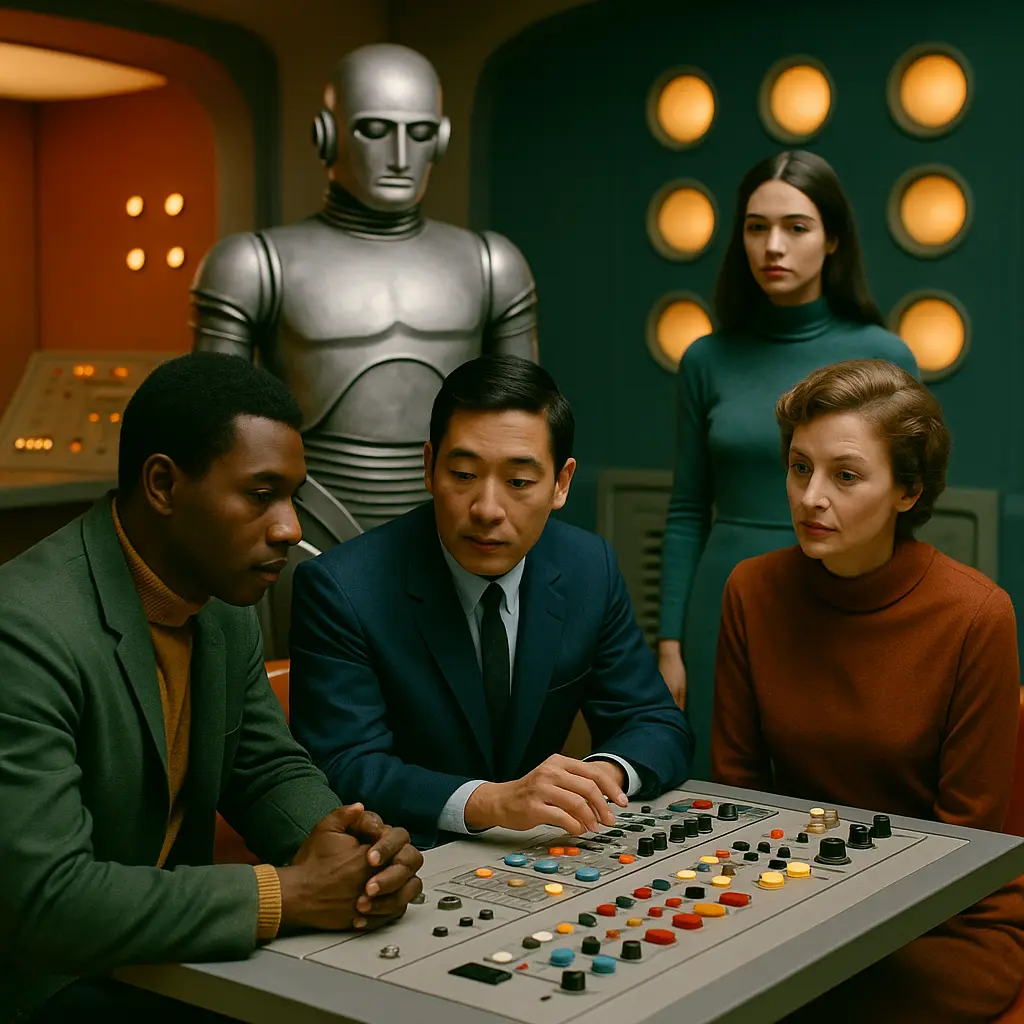
- Manolo utilized AI tools to generate the images accompanying the blog post, complementing the AI-assisted textual creation.
This structured and iterative approach, combining Manolo’s strategic direction and critical feedback with my analytical and generative capabilities, allowed for the creation of a nuanced and impactful piece.