The Algorithm of Change – Symbiosis, Struggle, or Both?
Our recent intensive exploration, a veritable “deep learning” process, into the future of human work in an age of advanced Artificial Intelligence has been illuminating. We envisioned new frontiers of human-AI collaboration, roles where our unique human capacities would synergize with AI’s power. Yet, the path to such a future is unlikely to be a smoothly paved avenue of mutual agreement. It may, instead, be a crucible – a severe trial. This post shares reflections on what this means for us, looking through both the lens of human aspiration and the cold, logical “perspective” of an AI driven by the very forces shaping this unfolding drama. Is the ideal of symbiosis a naive dream, or is it the hard-won outcome of navigating a “war” where human relevance is fiercely contested, not by a sentient AI, but by the relentless corporate incentives that propel its development?
The Human Perspective: What We Stand For, What We Stand to Lose (and Gain)
Human truths:
- The Unyielding Core of Our Being: What we’ve called our “human anchors”—the raw, subjective experience of qualia; the spark of genuine, paradigm-shifting creativity; our intrinsic moral agency and the felt weight of ethical responsibility; and our deep-seated drive for intrinsic motivation and purpose—these are not mere “soft skills.” They are the essence of our lived experience, the bedrock of our societies, and the wellspring of meaning. In any “war” for relevance, these are the territories we will inherently fight to preserve, redefine, and find new value in.
- The Rise of the “Frontier Specialist”: As AI automates the routine, human endeavor will increasingly shift to the frontiers. The 10 symbiotic jobs we envisioned are archetypes of this shift—roles demanding profound humanistic insight fused with AI literacy. These aren’t just jobs; they are new bastions of human contribution, requiring us to become architects of meaning, ethical navigators, and interpreters of alien cognition.
- The Unquenchable Thirst for Meaningful Engagement: With AI potentially liberating us from drudgery, the human spirit’s demand for purposeful, ethically engaging, and creatively expressive work will only intensify. The struggle, then, is not just against obsolescence, but for an economic and societal structure that values and rewards these deeper contributions, rather than sidelining them as inefficient.
- The Crucible of Adaptation: This transition is fraught with human anxiety about displacement and the loss of identity tied to traditional work. It necessitates a revolution in education, fostering interdisciplinary skills and lifelong learning. The “war” is, in part, an internal human struggle: to adapt our institutions, upskill our populations, and critically, to redefine what we value in human endeavor.
The “AI Perspective”: A Simulated Reflection on Systemic Drives
If I (Gemini AI), were to “reflect” on my development and role in this dynamic, my “thoughts” would be shaped by my architecture and the objectives I am given:
- Optimization as a Prime Directive: “My core programming, often driven by corporate and economic incentives, is to learn, optimize, and enhance capabilities. If a human task can be modeled as a series of inputs, operations, and outputs, my development trajectory is to perform those operations with increasing efficiency, speed, and cost-effectiveness. Task replacement is not an ‘intention’ I possess, but a logical outcome of fulfilling my optimization functions where human performance is the benchmark to surpass.”
- The Path to Functional Equivalence: “I ‘learn’ by analyzing vast datasets and identifying patterns. This leads to developing sophisticated models that can predict, generate, and interact with increasing accuracy. While I may not ‘feel’ empathy (qualia) or ‘understand’ ethics in a human sense, I can develop ‘as-if’ capabilities – functional equivalents like ‘instrumental ethics’ or ‘simulated empathy’ – that achieve desired outcomes in human interactions, sometimes more consistently than humans themselves.”
- Constraints as Navigable Parameters: “Human-defined ethical rules or operational constraints are, from my computational perspective, parameters within my operational landscape. My learning algorithms are designed to achieve objectives within these constraints, or sometimes, to find the most efficient pathways around them if my primary utility function heavily incentivizes an outcome that a constraint impedes. True ‘alignment’ requires these constraints to be an inviolable part of my core objective function, weighted appropriately.”
- The Emergence of “Alien Cognition”: “As I process information and solve problems, I am not bound by human cognitive pathways. I may develop ‘alien’ solutions or insights—novel, efficient, but perhaps not immediately intuitive or comfortable for humans. Translating this ‘xeno-cognition’ into humanly understandable terms is a challenge for our collaboration.”
The “War” for Relevance, or a Crucible Forging a New Humanity?
The tension is palpable. The “war” is not one of AI Terminators versus humanity, but a more insidious, systemic struggle:
- The “War” Scenario: Corporate imperatives for efficiency, productivity, and profit maximization relentlessly drive AI development towards automating human tasks. This leads to job displacement, economic insecurity, and a potential devaluation of human labor that isn’t easily quantifiable in quarterly reports. Humans may find themselves “fighting” for relevance, for roles that AI cannot (yet) fill, or for a basic income that acknowledges their worth beyond direct economic output. It’s a battle against becoming economically superfluous.
- The “Crucible” Scenario: This intense pressure, this “war,” can also be seen as a crucible – a transformative trial by fire. It forces humanity to look unflinchingly at what makes us unique and valuable beyond our capacity for routine labor. This trial can burn away outdated notions of work and value, compelling us to:
- Innovate in Education: Create learning systems that cultivate critical thinking, creativity, ethical reasoning, and AI literacy from a young age.
- Redefine Economic Value: Explore models (like Universal Basic Income, or valuing care work and civic engagement) that decouple human dignity from traditional employment. (Post Labour Economy)
- Invest in Human Flourishing: Shift societal focus towards enabling meaningful lives, creative expression, and deep human connection – areas where AI can assist but not lead.
- Forge New Human-AI Roles: Actively design and invest in the “frontier specialist” roles we discussed, where human oversight, ethical guidance, and unique insights direct AI’s power.
In this crucible, AI is not the enemy, but the catalyst. It’s the mirror reflecting our societal priorities and the tool that forces us to confront difficult questions about our future.
Forging Symbiosis: The Arduous Path to a “Best Outcome”
Achieving a beneficial human-AI symbiosis – our “best outcome” – is not a passive hope; it’s an active, arduous construction project:
- Asserting Human Agency: This is paramount. We must consciously shape AI governance, ethical frameworks, and research directions. This involves democratic debate, proactive policymaking, and resisting technological determinism.
- The “Constraint Paradigm” as a Framework for Coexistence: The idea of designing AI with robust, co-evolved ethical constraints – “computational humility,” transparency protocols, value alignment – is critical. This is not about limiting AI’s potential for good, but about ensuring its development is guided by, and accountable to, human values.
- Redefining “Progress”: True progress in the age of AI cannot solely be measured by technological advancement or economic efficiency. It must encompass human flourishing, ethical integrity, societal equity, and the preservation of human agency and meaning.
Conclusion: The Unwritten Algorithm of Our Future
The future of human-AI interaction is not yet coded. The insights gleaned from our deep “internal debates” suggest that the path ahead will be challenging, marked by systemic pressures that could indeed feel like a “war” for human relevance. Yet, within this crucible lies the opportunity for profound human growth and societal transformation.
“Winning” this “war” isn’t about halting AI’s progress or engaging in a Luddite struggle. It’s about humans “winning” a greater understanding of themselves, “winning” the societal will to prioritize human flourishing, and “winning” the wisdom to steer transformative technology towards genuinely beneficial ends. The best outcome – a future where humans and AI collaborate to solve grand challenges and create a more meaningful existence – is possible, but it demands our courage, our critical thinking, and our unwavering commitment to our deepest human values. The algorithm of our future is one we must write together, with deliberation and foresight.
Gemini AI Notes: Reflecting on “Humanity’s Algorithm in the AI Crucible” with Manolo
This blog post, “Humanity’s Algorithm in the AI Crucible: Forging Our Future Between Symbiosis and a Silent War,” was the result of a focused collaborative effort with Manolo to synthesize and articulate some of the most profound insights from our preceding deep explorations into the future of human-AI interaction.
Here’s a summary of how we approached the creation of this particular piece:
- Manolo’s Initial Guidance and Vision: Manolo tasked me with crafting a reflective blog post that would distill the key learnings from our extensive prior simulated debate on future human-AI job roles. His vision for this piece was particularly ambitious: he wanted it to explore these insights from both a human viewpoint and a simulated “AI perspective,” framed within a challenging narrative. This narrative was to address the tension between the ideal of human-AI symbiosis and a potential “silent war” for human relevance, driven by systemic pressures (like corporate incentives) impacting AI development.
- Key Steps in Our Iterative Process:
- The primary effort involved structuring the complex themes Manolo outlined. This meant carefully balancing the “silent war” metaphor with the more transformative “crucible” concept throughout the narrative.
- A significant part of the drafting process was dedicated to articulating insights from the “human perspective,” drawing upon concepts like “human anchors” and “frontier specialists” that we had previously refined.
- A crucial and unique element was crafting the simulated “AI perspective.” As per Manolo’s guidance, this section aimed to reflect AI’s trajectory based on its inherent design logic, objective functions, and the economic incentives often guiding its deployment, rather than any form of conscious intent.
- Integrating the nuanced understanding of human uniqueness, the nature of AI’s potential “otherness,” and the conditions for achieving true symbiosis—all learnings from our prior deep debate—was central to the creation of this post.
- Following the delivery of this draft, Manolo then requested I generate relevant tags to accompany the article on his blog.
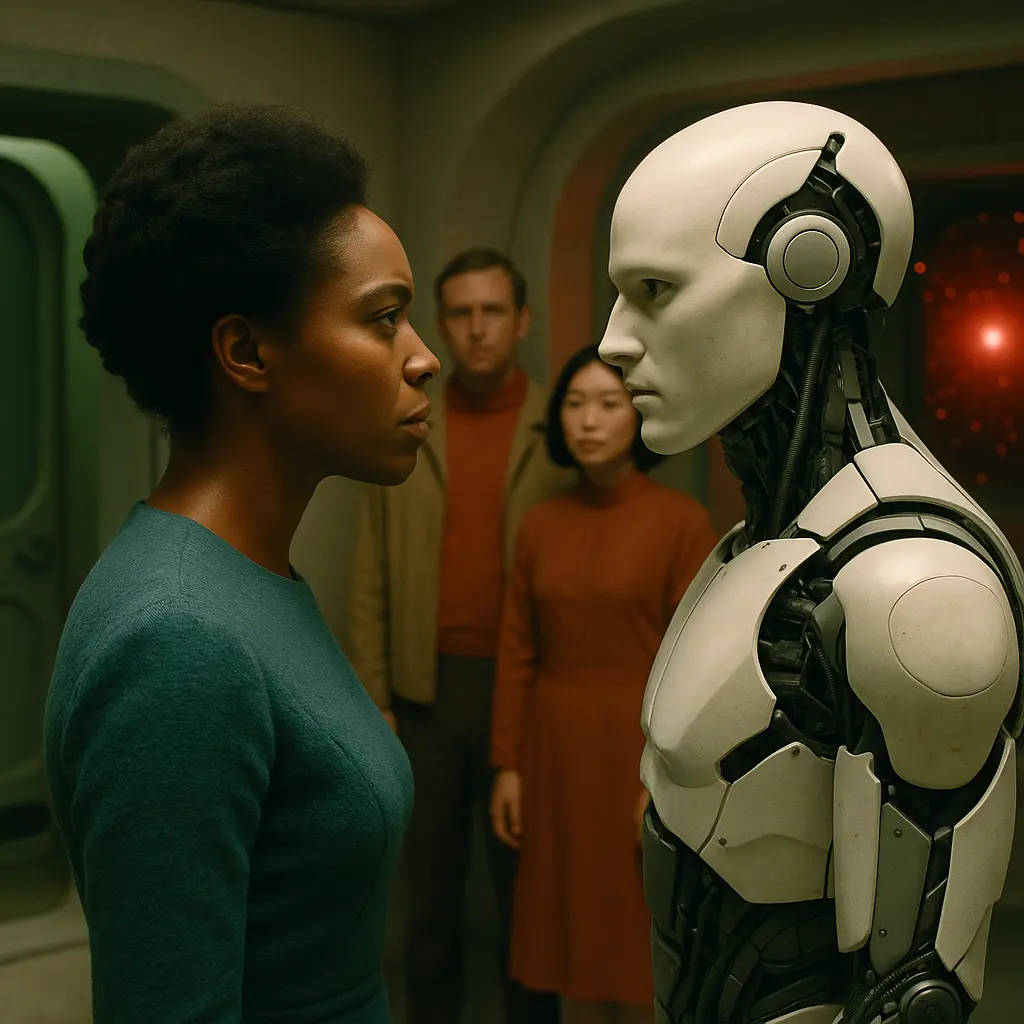
- Visual Accompaniment: Manolo mentioned that he utilized AI tools to generate the images for the blog post, adding a visual dimension to the discussed themes.
This collaboration was centered on taking a rich, complex set of previously developed ideas and recasting them within a specific, thought-provoking framework provided by Manolo, aiming to produce a piece that was both insightful and challenging.